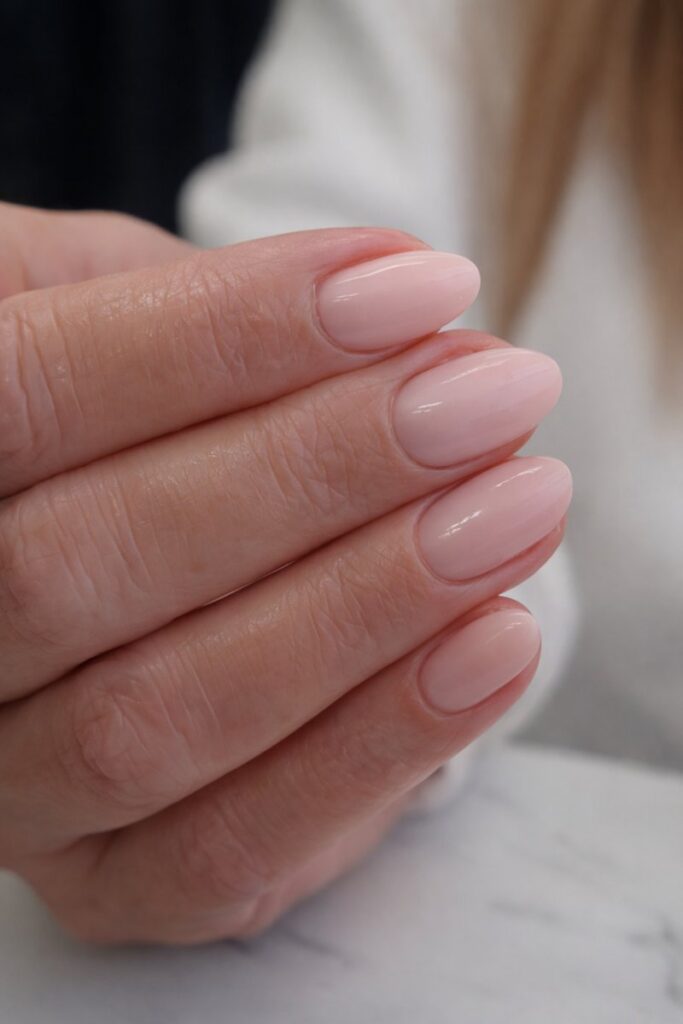
Your BIAB looked perfect when you left the salon. Smooth. Strong. Exactly what you wanted. Then a week later, the edge near your cuticle starts to separate. You press it down. It pops back up. By week two there’s a visible gap and you’re picking at it, which you know you shouldn’t do, but it’s right there and it’s driving you mad.
BIAB is supposed to last three to four weeks minimum. If yours is lifting before that, something went wrong during application, aftercare, or both. Here are the six most common reasons and what to do about each one.
This is the number one cause of early lifting and it happens at the preparation stage, before any product touches your nail.
Your nail plate has natural oils and moisture on its surface. If those aren’t fully removed before the base coat goes on, the product bonds to a layer of oil instead of bonding directly to keratin. Oil underneath product is like painting a wall without primer, where everything looks perfectly fine for the first day or two and then the whole thing starts peeling back from the edges because there was never a proper bond holding it there in the first place. Same principle. Same result.
Proper dehydration involves a two-step process: a dehydrator that removes moisture from the nail plate, followed by a primer that creates a chemical bond between the natural nail and the product. Skip either step or rush through them and the product has nothing solid to grip.
If your BIAB consistently lifts near the cuticle rather than at the tips, poor dehydration is almost certainly the cause. The cuticle area retains the most moisture because it’s closest to living skin, so that’s where insufficient dehydration shows up first.
The fix: Find a tech who takes nail preparation seriously. At Aesthete Beauty, the dehydration step is never rushed regardless of how busy the schedule is, because skipping it means the rest of the appointment was a waste of everyone’s time.
BIAB needs to sit on the nail plate only. Not on the skin. Not on the cuticle. Not overlapping even slightly onto the soft tissue surrounding the nail.
When product touches skin, it can’t bond properly because skin is a completely different surface from nail. That section will lift first, and once one edge lifts, moisture gets underneath and the lifting spreads outward from that starting point like a slow peel.
This is a precision issue. It’s the difference between a tech who applies product right up to the cuticle line with millimetre accuracy and a tech who floods product over the edges because it’s faster. The result looks similar in the first few hours. A week later, the difference is obvious.
The fix: Russian manicure preparation before BIAB application creates the cleanest possible cuticle margin. Dead skin is removed with an e-file so the product boundary is precise and clean, with no stray skin creating a bridge between the nail plate and the surrounding tissue. At Aesthete Beauty, BIAB with Russian manicure preparation starts from £79 and it’s the combination that gives the longest wear.
BIAB cures under an LED lamp, and the curing light needs to penetrate through the full thickness of each layer to harden the product completely. Thick layers don’t cure all the way through. The surface hardens but the middle stays soft, which creates a weak layer in the structure that eventually fails.
Under-cured product also generates more heat during the curing process, which is why some clients report a burning sensation under the lamp. If your tech is applying thick layers and the lamp feels uncomfortably hot, those two things are connected.
Proper application uses multiple thin layers, each one fully cured before the next goes on. It takes longer. It uses more lamp cycles. But every layer is solid all the way through, which means the finished overlay has no hidden weak points waiting to let go.
The fix: This one’s entirely on the tech. Thin layers, full cure, no shortcuts. If your BIAB feels uncomfortably hot during curing, mention it. A good tech will adjust by applying thinner coats.
Prying open ring-pull cans. Peeling stickers off packaging. Scraping labels. Levering open lids. Picking at things. Every one of these actions puts concentrated force on the free edge of the nail and transfers it to the bond between the product and the nail plate.
BIAB is strong but it’s not indestructible. Repeated mechanical stress at the same point will eventually overcome the bond, and once the first microscopic gap appears, moisture gets in and the lifting starts. The frustrating part is that you rarely notice the moment it happens. No crack. No warning. You just wake up one morning, look at your nails, and an edge has popped where yesterday it was flat.
The fix: Use tools for tool tasks. It sounds patronising but it’s genuine. Keep a small knife or a coin in your pocket for ring-pulls. Peel stickers with your fingertip pad, not your nail edge. These tiny habit changes add days to the life of your BIAB because the bond never gets that first crack to work from.
Water is BIAB’s quiet enemy. Short contact with water is fine. Washing your hands, showering, normal daily stuff. But prolonged soaking weakens the bond over time.
Swimming, long baths, washing dishes without gloves, soaking in hot tubs. These extended water exposures let moisture creep under the edges of the product through microscopic channels that you can’t see. Once water gets between the product and the nail plate, the bond in that area is compromised and lifting follows.
Hot water is worse than cold because heat expands the nail plate slightly, opening those microscopic channels wider. The steam from a dishwasher when you open the door mid-cycle is enough to create problems if it happens repeatedly.
The fix: Rubber gloves for washing up. Not optional, not sometimes, every time. If you swim regularly, mention it to your tech so they can apply an extra seal coat at the edges. And avoid soaking your hands in hot water for longer than a few minutes.
BIAB grows out with your nail. As the nail extends past the cuticle, the product shifts position relative to the nail’s stress points. What was perfectly balanced at week one has a different weight distribution by week four because the overlay has moved forward while the nail has grown from the base.
At some point, the product near the cuticle becomes thin enough or stressed enough that it starts to separate. This isn’t a failure of the application. It’s just physics. Everything has a wear limit, and knowing when yours is means booking your infill before the lifting starts rather than after.
Most clients find their sweet spot between three and five weeks depending on how fast their nails grow and how much daily stress their hands take. If you’re consistently seeing lifting at a specific week, book your infill one week earlier than that. Preventing the first lift is always easier than repairing one that’s already started.
The fix: Track when lifting starts across your first few appointments. If it happens at week three, book infills at week two and a half. At Aesthete Beauty, BIAB infills start from £49 and take about an hour.
Russian manicure preparation plus BIAB plus proper aftercare. That’s the formula.
Russian prep removes the dead skin and moisture that cause lifting at the cuticle edge. Thin BIAB layers cure fully with no weak points. Gloves during washing up keep water from undermining the bond. And booking your infill before the lifting starts means the overlay never reaches the point where it’s vulnerable.
Clients who do all four of these consistently get five to six weeks between appointments. Not occasionally. Routinely. The system works when every step in the chain does its job, and no single step, no matter how well it’s done, can compensate for another one being skipped, which is why salons that rush preparation or skip dehydration can’t solve lifting problems by using better product or a more expensive lamp.
Why does my BIAB lift after one week?
Almost always a preparation issue. Either the nail wasn’t fully dehydrated before application, product touched the cuticle skin, or the layers were too thick to cure completely. All of these are fixable by finding a tech who takes preparation seriously.
Is BIAB supposed to last four weeks?
With proper preparation and reasonable aftercare, yes. Three to four weeks with standard prep. Five to six weeks with Russian manicure preparation. If yours consistently lifts before three weeks, the application needs improving.
Can I glue down a lifted BIAB edge?
Don’t. Superglue or nail glue under a lifted edge traps moisture and bacteria in a sealed pocket against your nail plate. Have it professionally repaired or removed instead. A repair appointment takes about fifteen minutes and costs £6 at Aesthete Beauty.
Does cuticle oil cause BIAB to lift?
No. Cuticle oil applied after curing doesn’t weaken the bond. In fact, it helps by keeping the skin around the nail flexible and healthy, which reduces the physical stress on the product edges. Apply it daily.
Should I get Russian manicure prep with my BIAB?
If you want the longest possible wear time, yes. Russian prep creates the cleanest nail surface for BIAB to bond to, and the precise cuticle margin means product sits exactly where it should without overlapping onto skin. Most lifting issues at the cuticle edge disappear entirely with Russian prep.
How often should I get BIAB infills?
Every three to four weeks with standard prep. Every four to five weeks with Russian prep. If you notice lifting starts at a specific week, book one week before that to stay ahead of it.
Why does BIAB burn under the lamp?
Thick layers generate more heat during curing because the chemical reaction is happening in a larger volume of product at once. Thinner layers cure with less heat. If it burns, tell your tech. They can adjust the application technique to reduce heat without affecting the result.
If your BIAB has been lifting and you’ve been blaming the product, it might be the process. Proper preparation, thin layers, precise application, and the right aftercare routine solve most lifting issues entirely.
Radina has over 11 years in the industry and BIAB preparation is one of her specialisms. BIAB Manicure from £49. BIAB with Russian Manicure from £79. Infills from £49. All HEMA-free and TPO-free.
Aesthete Beauty, 76 Bell St, Dundee DD1 1HF. Book online any time or call 01382 217888.
Whether you're looking to book a treatment or just have a question, we'd love to hear from you. Book online any time or get in touch using any of the options below.
We serve clients from across Dundee and the surrounding areas including the West End, Broughty Ferry, Newport-on-Tay, Monifieth, Carnoustie, and further afield.